
Last updated July 15, 2026
Garage Door Repair Maintenance Checklist for Buffalo Homeowners
After 20 years of Buffalo service calls, there’s a pattern: the doors that fail on the coldest day of the year are the ones that skipped one specific maintenance step in October. We’ve seen it in North Buffalo, we’ve seen it in Cheektowaga, we’ve seen it in West Seneca — a homeowner who meant to get around to it, then the lake-effect hits, the torsion spring snaps at 6 a.m., and suddenly they’re late for work with a car trapped in the garage. This isn’t a generic maintenance guide. This is the exact checklist William Davis uses to keep Buffalo garage doors running through single-digit mornings, freeze-thaw cycles that wreck hardware, and snow loads that test every component. Follow this, and you’ll spot problems before they strand you.
Quick Answer
Buffalo homeowners should perform garage door maintenance twice yearly — a pre-winter prep in October and a post-winter reset in April — focusing on cold-weather lubrication, weatherstripping integrity, spring tension checks, and track clearing from salt and ice buildup. In our experience, the doors that survive Buffalo’s temperature swings without failure are the ones that get this seasonal attention, not annual — learn more in our How to Hire a Garage Door Contractor in Buffalo: A Step-by-Step Guide.
Table of Contents
- The Pre-Winter “Buffalo Prep” Sequence (October)
- Weatherstripping: Your First Defense Against Lake-Effect Moisture
- Spring Tension Checks for Buffalo’s Temperature Swings
- Tracks, Rollers, and What Heavy Snow Loads Do to Them
- Opener and Safety System Checks Before the Deep Freeze
- The Post-Winter Reset (April)
- Cold-Weather Lubrication: What Works Below 0°F
- Common Mistakes to Avoid
- When to Call a Professional
- Frequently Asked Questions
The Pre-Winter “Buffalo Prep” Sequence (October)
Every October, we get a wave of calls from Buffalo homeowners who suddenly remember their garage door as the first cold snap hits. The smart ones — the ones who never call us in February — do this sequence before Halloween.
Here’s the order that matters. Don’t skip steps, and don’t reverse them.
- Disconnect the opener and run the door manually. A properly balanced door should stay put at waist height. If it drifts up or crashes down, the spring tension is off — and Buffalo’s winter cold will make that worse, not better. We’ve seen doors in Elmwood Village that were “a little heavy” in October become completely unmovable by January.
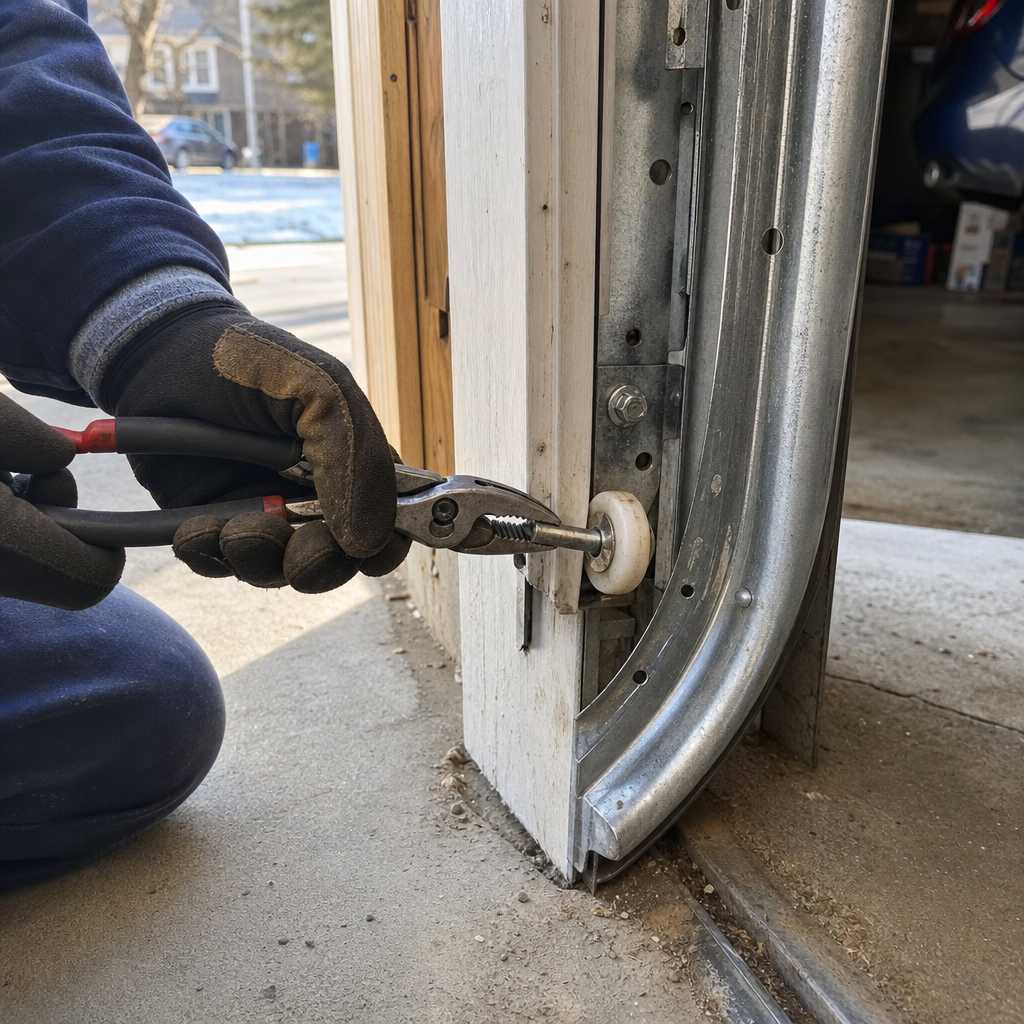
- Inspect every roller. Nylon rollers crack from cold brittleness. Steel rollers rust from road salt that gets tracked in. In South Buffalo, where older homes have doors that have seen 15+ winters, we replace roller sets preventively every 8-10 years. Wiggle each roller — any play in the shaft means it’s walking out of the track soon.
- Check all fasteners. The vibration of daily operation loosens bolts. The expansion and contraction of Buffalo’s wild temperature swings loosens them faster. Hit every nut and bolt on the track brackets, opener rail, and door hinges with a socket wrench. Don’t over-tighten — you can strip lag bolts in older door jambs.
- Test the auto-reverse and photo eyes. Clean the lenses with a dry cloth (moisture in October air leaves film). Place a 2×4 flat on the floor — the door should reverse on contact. Wave a broom through the beam while closing — it should reverse immediately. In Buffalo’s low winter light, dirty photo eyes cause more false trips than actual obstructions.
- Lubricate correctly — see the dedicated section below. This is the step that separates doors that survive winter from doors that don’t.
We’ve been called to garage door repair in Buffalo homes where the homeowner did four of these five steps. The one they skipped was always the one that failed them.
Weatherstripping: Your First Defense Against Lake-Effect Moisture
The bottom seal on your garage door is the most overlooked failure point in Buffalo homes. It’s also the one that causes the most expensive secondary damage.
Here’s what happens: lake-effect snow piles against the door. The bottom seal is cracked or compressed. Meltwater seeps under the door, hits the concrete, and refreezes. Now your door is frozen to the floor. You hit the opener button. The opener strains, the rail bends, or the door tears itself out of the bottom fixture. We’ve replaced entire door sections in January because a $15 rubber seal failed in October.
What to check:
- The bottom U-shaped retainer. Look for cracks in the vinyl or aluminum channel that holds the rubber seal. In Buffalo’s salt environment, aluminum retainers corrode at the screw holes.
- Seal compression. Close the door on a piece of paper. You should feel drag when pulling it out. If it slides freely, the seal is too compressed to block water — replace it.
- Side and top seals. These matter less for water but critical for wind. A Buffalo nor’easter will find every gap. Look for daylight around the door perimeter when it’s closed.
- The threshold. If your concrete apron is cracked or sloped toward the door, no seal will save you. Water management is part of door maintenance in this climate.
In Riverside and Black Rock, where homes sit close to the water table, we see more bottom-seal failures than anywhere else in our service area. The freeze-thaw cycle is relentless.
Replacement is straightforward for a handy homeowner — retainer and seal kits run $20-40. But if your door is frozen to the floor already, don’t force it. That’s when hardware tears and safety cables become critical.
Spring Tension Checks for Buffalo’s Temperature Swings
Torsion and extension springs are where we draw a hard line on DIY. A wound torsion spring stores enough energy to cause serious injury or death. We’ve seen broken wrists, facial injuries, and worse from homeowners who watched a video and thought they could handle it.
That said, you can check for warning signs without touching the spring itself.
Visual inspection (safe to do):
- Gap in a torsion spring. Look for a visible separation in the coils — usually 2-3 inches where the spring has snapped. The door may still operate if it has two springs and one is intact, but it’s working dangerously hard.
- Extension spring wear. Look for gaps between coils when the door is closed (they should be mostly touching). Check the safety cable — it should run through the center of the spring, not dangling loose.
- Rust and corrosion. Buffalo’s humidity swings promote surface rust. Light surface rust is cosmetic. Flaking, pitted rust weakens the steel. We’ve replaced springs in Amherst that looked fine externally but had internal corrosion from years of condensation cycling.
The balance test (also safe):
Disconnect the opener. Lift the door manually to waist height. Release it. A balanced door stays put. If it drifts down, the springs are weak. If it shoots up, they’re too strong. Both conditions strain the opener and create safety hazards.
Buffalo’s temperature swings accelerate spring fatigue. A spring rated for 10,000 cycles might get 7,000 here because the metal expands and contracts dramatically twice daily some weeks. We recommend professional spring inspection every two years minimum — annually if your door sees heavy use or is over 10 years old.
When springs need adjustment or replacement, call a professional. The owner is the technician at our shop — William Davis handles spring work personally, with the tools and training to do it safely.
Tracks, Rollers, and What Heavy Snow Loads Do to Them
Buffalo snow doesn’t just fall — it piles, drifts, and freezes into immovable masses. Your garage door track system isn’t designed to take lateral pressure from snow, but it gets it anyway.
Post-storm inspection protocol:
- Clear the track path completely. Not just the door width — the full vertical run on both sides. Snow compressed into the track gap freezes and jams rollers. We’ve seen homeowners burn out LiftMaster openers because the motor strained against ice-blocked rollers.
- Check for track misalignment. Look at the gap between rollers and track — it should be consistent. If snow load pushed the track inward even slightly, rollers bind and wear unevenly. A bent track section from snow pressure will cause repetitive failures until it’s replaced or straightened.
- Inspect roller condition after ice events. Nylon rollers that got wet and froze may have micro-cracks. Steel rollers may have rust spots starting. Spin each roller by hand — it should turn freely. Grinding or stiffness means replacement.
- Look for salt corrosion. Road salt gets everywhere in Buffalo. It crystallizes on track surfaces, accelerates rust, and turns lubricant into abrasive paste. Wipe tracks with a clean rag — you’ll often find white salt residue even in spring.
In neighborhoods like Kaisertown and Lovejoy, where narrow driveways force snow plowing close to garage doors, we see more track damage from physical impact than anywhere else. A plow blade that kisses the track leaves a dent that causes roller jump — the door comes off track entirely, usually at the worst possible moment.
Track alignment is precision work — measured in millimeters. If you suspect misalignment from snow load or impact, professional adjustment prevents the cascade of damage that follows a derailed door.
Opener and Safety System Checks Before the Deep Freeze
Your opener works harder in winter — period. Cold-stiffened seals, heavier doors from ice accumulation, and reduced lubricant flow all increase mechanical load. The opener compensates until it can’t.
Pre-winter opener checklist:
- Force settings. Every opener has down-force and up-force adjustments. These drift over time. Test with the 2×4 block — the door should reverse without crushing it. If it doesn’t reverse, the force is too high (dangerous) or the safety system has failed (also dangerous). Never increase force to compensate for a stiff door — fix the door instead.
- Chain or belt tension. A loose chain slaps the rail and jumps sprocket teeth under load. A too-tight belt strains bearings. In cold weather, belt material stiffens and behaves differently. Check your manual for spec — or have us verify it during a tune-up.
- Battery backup test. Buffalo power outages spike during winter storms. If your opener has battery backup, test it monthly. A dead backup battery means you’re manually lifting a heavy door in a dark, cold garage.
- Remote range check. Cold reduces battery output. If your remote seems weaker in winter, start with fresh batteries before assuming opener problems. We get calls every December for “opener failure” that’s just a $3 battery.
- Wall button and keypad. These see less use but fail from moisture intrusion. The wall button in an attached garage is especially vulnerable to condensation from the house-to-garage temperature differential.
We’re certified on Wayne Dalton, Craftsman, LiftMaster, and five other major brands — so when we say “check your manual,” we mean the actual factory spec, not generic advice. Your door, your brand — we know it.
For garage door opener service in Buffalo, we handle everything from force calibration to full replacement, including smart opener upgrades that let you monitor and control the door remotely — useful when you’re stuck at work and need to let in a delivery or service person.
The Post-Winter Reset (April)
April in Buffalo is not spring — it’s damage assessment. The freeze-thaw cycle has done its work. Road salt has infiltrated every mechanism. Here’s what we do on our own seasonal reset, and what you should do on yours.
- Full lubrication purge. Whatever you applied in October has attracted salt, dirt, and moisture. Wipe old lubricant from hinges, rollers, and springs with a clean rag. Re-apply fresh — see the cold-weather section for product specifics.
- Hardware re-torque. Another full pass with a socket wrench. The expansion-contraction cycle loosens fasteners we tightened in October. In 20 years, we’ve never seen a door that didn’t need at least two bolts snugged in April.
- Spring re-inspection. The winter load is cumulative. Springs that were marginal in October may show new gaps, elongation, or coil distortion. This is the second-highest failure window after the first cold snap — springs that survived winter often fail in the “relief” of warmer weather when metal relaxes.
- Weatherstripping replacement if needed. If the bottom seal made it through winter, it may be compressed beyond recovery. The April check is your last chance to replace it before spring rains test it.
- Opener strain assessment. Did the opener sound labored all winter? Does it now seem “fine” in warmer weather? That seasonal variation masks developing problems. A door that was stiff in January and easy in April still has a problem — the problem just got smaller, not gone.
- Clean and inspect photo eyes. Salt film, road grime, and condensation build up. Clean with glass cleaner, not just a dry cloth. Align if the indicator lights show misalignment — even a few degrees off causes intermittent failures.
The post-winter reset takes about 90 minutes for a thorough job. The homeowners who do it — or have us do it — are the ones whose doors run silently through summer and are ready for the next Buffalo winter.
Cold-Weather Lubrication: What Works Below 0°F
This is the maintenance step that separates Buffalo survivors from Buffalo casualties. Use the wrong product, and you’re actively making things worse.
What NOT to use:
- Standard WD-40. It’s a water displacer and light solvent, not a lubricant. It evaporates, leaves a sticky residue that attracts grit, and turns to gum in cold. We’ve opened track sections caked with black WD-40 sludge that caused more friction than bare metal.
- General-purpose household oils. 3-in-1 oil, motor oil, cooking oil — all thicken or gum in cold. They also attract dust and salt particles that become abrasive compound.
- Silicone sprays without temperature rating. Some silicone products thicken below 20°F. If the can doesn’t specify performance to -20°F or lower, assume it won’t work here.
What TO use in Buffalo:
- Lithium-based grease, spray or tube. White lithium grease maintains flow down to -30°F and resists water washout. We use it on hinges, rollers (the bearing, not the tread), and spring coils.
- Silicone spray rated for extreme cold. Specifically formulated garage door lubricants from reputable manufacturers list operating temperature ranges. Verify -20°F minimum.
- Proprietary track lubricants. Some professional-grade products contain Teflon or similar dry-film lubricants that don’t attract debris. We use these in high-salt environments.
Application specifics:
Apply sparingly. Excess lubricant is not better — it’s a dirt magnet. One light coat on hinge pins, roller bearings (spin the roller to work it in), and spring coils. Wipe the track with a clean, dry rag — do not lubricate the track surface. The roller tread needs friction to drive; oily tracks cause slippage and uneven wear.
In our experience, the doors that fail in Buffalo’s coldest weeks are often over-lubricated with the wrong product months earlier. The owner meant well. The chemistry betrayed them.
Common Mistakes to Avoid
- Using WD-40 as a lubricant. We said it above, but it bears repeating — this is the single most common error we correct in Buffalo homes. It displaces water briefly, then creates a sticky film that collects salt and grit.
- Ignoring the door until it fails. The “if it ain’t broke” approach costs more. A spring that fails catastrophically often damages cables, drums, and bottom fixtures. Preventive replacement of a $200 spring pair beats emergency replacement of $600 in components plus the service call premium.
- Adjusting spring tension DIY. The videos make it look manageable. The emergency rooms see the results. We’ve treated this as a hard safety line for 20 years — it’s non-negotiable.
- Clearing snow with the door as a plow. Pushing snow with the door bottom forces it out of alignment, damages the bottom seal, and strains the opener. Shovel first, open second. Every time.
- Neglecting the manual release. Every opener has a red emergency release cord. Test it quarterly — if it’s stiff or corroded, replace it. In a power outage or opener failure, this is your only way to get the car out. We’ve responded to calls where the cord broke because it hadn’t been used in years.
- Assuming all brands are the same. A Craftsman opener from 2008 has different force specs than a 2023 LiftMaster. A Wayne Dalton TorqueMaster spring system requires entirely different handling than standard torsion. Generic advice from national websites often doesn’t apply to your specific hardware.
When to Call a Professional
Some maintenance is homeowner-appropriate. Some is not. Call a professional when you encounter:
- Any visible gap or separation in a torsion or extension spring
- A door that won’t stay balanced at waist height when disconnected from the opener
- Track misalignment, bending, or roller jump (door coming out of track)
- Opener force settings that need adjustment — this affects safety system function
- Any door section crack, dent, or separation in the panel construction
- Cable fraying, unraveling, or detachment from the bottom fixture
Garage Door Repair from Vanguard Garage Door Repair Greater Buffalo offers free estimates in Buffalo — call (888) 602-5316. William Davis handles the assessment personally, and we’ll give you an honest read on what’s needed now versus what can wait. Two decades of garage door experience means we’ve seen every scenario, and we don’t sell repairs that aren’t warranted.
For new garage door installation in Buffalo, we also provide full replacement when repair isn’t cost-effective — same owner-led service, same multi-brand expertise.
Frequently Asked Questions
Twice yearly — October before winter, and April after. Buffalo’s climate is harder on garage doors than most of the country, and the seasonal prep/reset cycle catches problems before they strand you. Call (888) 602-5316 for a free estimate if you’d rather have us handle it.
A professional tune-up in the Buffalo market typically runs $89–$150 depending on door size, number of springs, and whether opener calibration is included. Full maintenance with spring tension adjustment, hardware torque, lubrication, and safety system testing takes 60–90 minutes. Call (888) 602-5316 for an exact quote — estimates are free.
No — WD-40 is not a lubricant and worsens cold-weather performance. It evaporates and leaves a sticky residue that thickens in cold, attracts salt and grit, and increases friction. Use white lithium grease or cold-rated silicone spray instead. We’ve replaced more hardware damaged by WD-40 misuse than any other single maintenance error in Buffalo.
Buffalo’s temperature swings cause steel expansion and contraction that accelerates metal fatigue. A spring that might last 10,000 cycles in a stable climate may fail at 7,000 here. The freeze-thaw cycle also promotes internal condensation and corrosion. We inspect springs every two years minimum for Buffalo homeowners, annually for older doors.
Repair is cheaper for isolated issues — a single spring, one damaged panel, or opener failure on a door under 15 years. Replacement makes sense when multiple components are failing, the door lacks modern safety features, or repair costs exceed 50% of replacement. William Davis provides honest assessment on this trade-off during every free estimate — no pressure for unnecessary replacement.
We offer emergency garage door service for urgent situations — doors stuck open, vehicles trapped, or security-compromising failures. For non-emergency maintenance, we schedule within a few business days. When it can’t wait, call (888) 602-5316 and we’ll prioritize getting William Davis to your Buffalo home.
The Bottom Line
Buffalo garage doors face a uniquely hostile environment — temperature swings that test metal, lake-effect moisture that infiltrates seals, and road salt that corrodes everything it touches. A generic maintenance schedule won’t protect against these specific threats. The pre-winter prep in October, with correct cold-weather lubrication and weatherstripping verification, prevents the failures we see every January. The post-winter reset in April undoes accumulated damage before it compounds. Spring safety remains non-negotiable DIY territory. And the 1,200+ homeowners who’ve rated our work can’t be wrong — consistent, experienced attention to your door pays off in reliability when you need it most. For more guides & resources, visit our blog.
Written by William Davis, Owner & Lead Technician at Vanguard Garage Door Repair Greater Buffalo, serving Buffalo since 2006.