
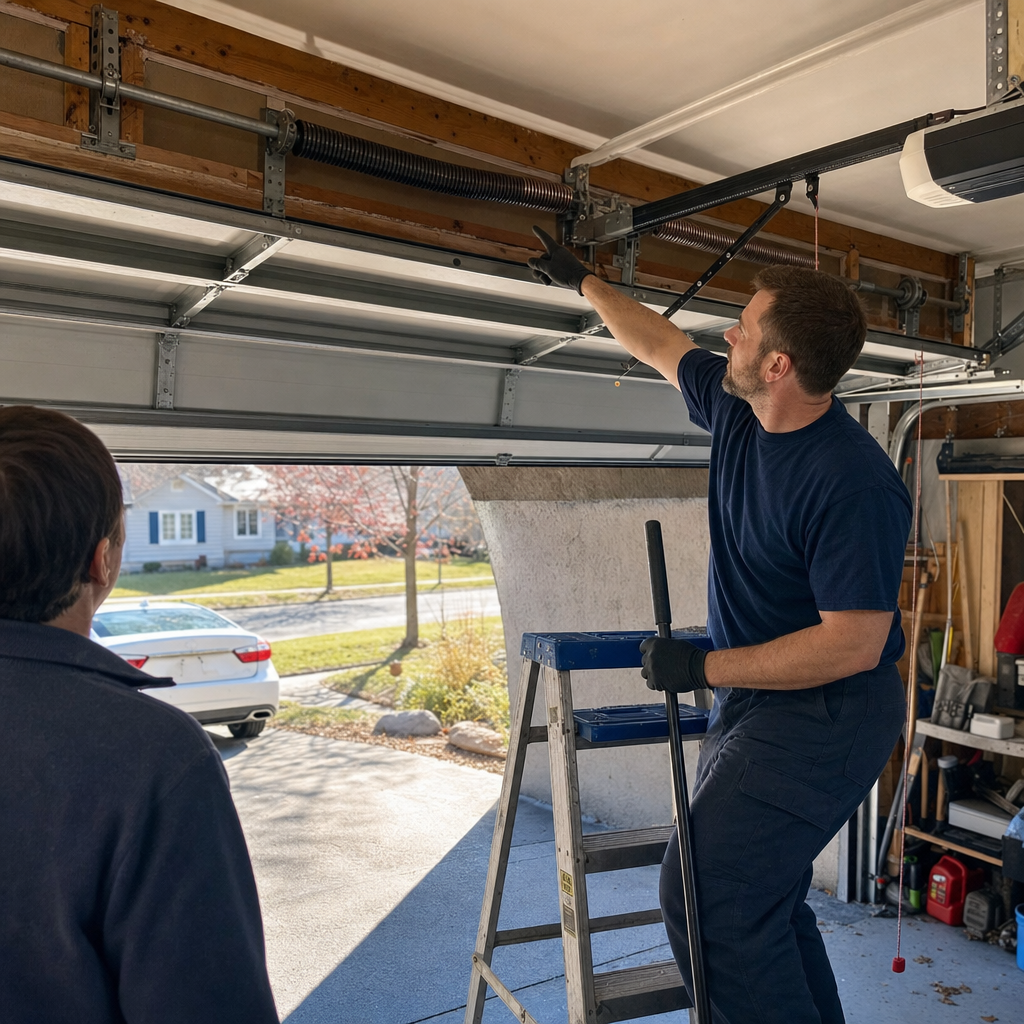
How to Program a Garage Door Opener in Buffalo, NY
Programming a garage door opener in Buffalo typically takes under five minutes: press and release the colored “Learn” button on the motor unit, then press the button on your remote within 30 seconds until the opener lights flash or you hear a click. The exact button color and sequence vary by brand and generation—LiftMaster and Chamberlain use purple, red, orange, yellow, or green buttons depending on the year, while Genie, Craftsman, and Wayne Dalton each use their own timing patterns. If you’re standing in an unheated alley garage in Elmwood Village or Allentown and the Learn button doesn’t respond, wait a full 60 seconds between steps; at -10°F, older units can lag. Still stuck? Call Vanguard Garage Door Repair Greater Buffalo at (888) 602-5316—we’ll walk you through it or come sort it out.
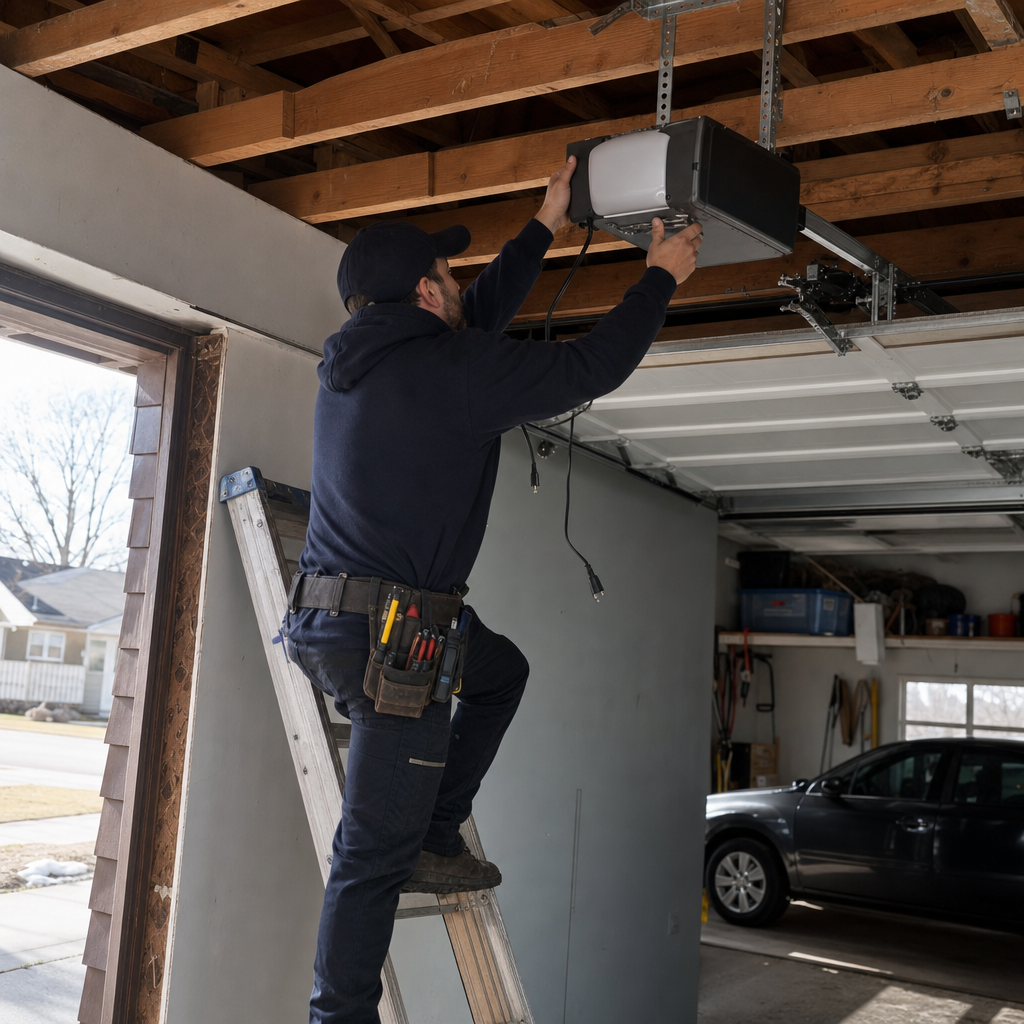
Why Buffalo’s Alley Garages Make Programming Trickier Than the YouTube Videos Suggest
Most online tutorials assume a heated attached garage with a 2015 opener and a universal remote fresh from the box. That scenario doesn’t match what we encounter across Buffalo’s older neighborhoods.
William Davis, Owner & Lead Technician at Vanguard Garage Door Repair Greater Buffalo, grew up in Black Rock helping his father maintain the carriage-style garages off Niagara Street. He’s spent two decades working on the detached, unheated alley garages that dominate Elmwood Village, Allentown, North Buffalo, and the West Side—structures built between 1890 and 1940 with 8-foot-wide openings, deteriorating hardware, and concrete floors that have heaved and cracked from decades of freeze-thaw cycles.
Here’s the pattern we see constantly: a homeowner buys a modern universal remote, follows the generic steps, and the opener never enters programming mode. The real culprit is usually one of three Buffalo-specific issues:
- Pre-1996 fixed-code openers in older alley garages cannot accept rolling-code remotes—no amount of Learn-button pressing will bridge that gap
- HomeLink in-car systems require a completely different sequence than handheld remotes, and most owners attempt the wrong one
- Cold-weather lag in unheated garages causes older LiftMaster and Chamberlain units to miss timed inputs when the motor housing sits below zero
Knowing which of these you’re dealing with saves you an hour of frustration and determines whether a $30 remote solves your problem or you need a compatibility assessment.
The Learn-Button Method by Brand: What Actually Works
Every major opener brand Vanguard Garage Door Opener services uses a slightly different programming protocol. Below are the sequences we use in the field—verified across 20 years of hands-on work in Buffalo homes.
LiftMaster, Chamberlain, and Craftsman (Same Parent Company, Different Eras)
These three dominate Buffalo’s installed base, especially in homes built or renovated between 1993 and 2015. The Learn button color tells you which protocol applies:
| Button Color | Era / Security | Programming Steps |
|---|---|---|
| Green | 1993–1995, Billion Code | Press Learn once → press remote button within 30 seconds → opener light flashes |
| Red or Orange | 1996–2005, Security+ rolling code | Press Learn once → press and hold remote button 2 seconds → light flashes or clicks twice |
| Purple | 2006–2014, Security+ 2.0 | Press Learn once → press remote button once → light flashes, press remote again to confirm |
| Yellow | 2011–present, MyQ-enabled | Press Learn for 2 seconds until LED lights → press remote button once → LED turns solid then off |
Buffalo cold-weather note: In unheated alley garages during January or February, we’ve seen yellow- and purple-button units fail to register the remote press if the motor housing temperature drops below -5°F. Wait 60 seconds after pressing Learn—not 30—before pressing your remote. The circuit board needs that extra time to stabilize. If you’ve tried twice with the shorter interval, give the unit ten minutes to warm slightly and restart with the longer pause.
William’s field rule: “If I wouldn’t put it on my own garage, I’m not putting it on yours.” That includes walking a homeowner through a programming fix over the phone when it’s genuinely a procedure issue, not a hardware failure.
Genie (Intellicode Systems)
Genie openers use a “Program Set” button rather than a Learn button, typically located behind the light lens. Press and hold until the round LED turns blue, then the long LED begins flashing purple. Press your remote button once within 30 seconds. The LEDs will stop flashing and go solid when paired.
Genie’s Intellicode rolling system changed in 2012; remotes from the older 12-switch DIP era won’t pair with post-2012 openers. We encounter this mismatch frequently in Buffalo’s rental properties, where landlords replace a failed opener with a newer Genie but leave the old remotes in tenant hands.
Wayne Dalton (Quantum and Classic Drive Models)
Wayne Dalton’s programming is the least intuitive of the major brands. On Quantum models, press the “Program” button on the opener—the motor unit’s LED will glow steady. Press the remote button until the LED blinks three times. For Classic Drive units, the sequence requires pressing the wall control’s “Light” button while simultaneously pressing the remote button, which confuses most homeowners who expect the motor unit itself to have a Learn button.
Wayne Dalton’s proprietary radio frequency (303 MHz on older units, 372.5 MHz on newer) also means universal remotes rarely work regardless of programming steps. If you have a Wayne Dalton and a generic remote, compatibility—not procedure—is almost certainly your issue.
Clopay and Amarr (Opener-Brand Partnerships)
Clopay and Amarr manufacture doors, not openers, but they frequently bundle LiftMaster or Chamberlain units with new installations. Check the motor unit itself for the actual opener brand—programming follows that manufacturer’s protocol, not the door brand. Raynor openers, common in some Western New York commercial installations, use a Chamberlain-compatible Learn system with a blue or purple button.
The Rolling-Code vs. Fixed-Code Problem: When Programming Is Mathematically Impossible
This is the single most common source of programming failure we diagnose in Buffalo’s older housing stock, and no amount of button-pressing will overcome it.
Before 1996, garage door openers used fixed-code systems: the remote transmitted the same signal every time, encoded by physical DIP switches (small toggles inside the remote). After 1996, major brands switched to rolling-code technology—each press generates a unique, encrypted signal that changes with every use.
Here’s the critical incompatibility: a rolling-code remote cannot communicate with a fixed-code receiver, and vice versa. The frequencies and encryption protocols are fundamentally different. If your Buffalo alley garage has a 1992 Craftsman or pre-1996 Genie, and you’re trying to program a modern universal remote, you are attempting to pair two devices that speak different languages.
How to identify your system:
- Fixed-code remotes have visible DIP switches (usually 9 or 12 small toggles) inside the battery compartment
- Fixed-code openers have no Learn button—only a “Radio” or “Set” button, or DIP switches on the motor unit itself
- Rolling-code openers always have a colored Learn button
If you’ve confirmed a fixed-code opener, your options are: find a vintage DIP-switch remote (increasingly scarce), install a compatible external receiver kit ($80–$150 parts plus labor), or replace the opener. For a unit pushing 30 years in Buffalo’s salt-corrosion environment, replacement often makes more sense than retrofitting. Garage Door Opener in Buffalo covers new installation options if you’re at that decision point.
HomeLink Programming: The Sequence Most Buffalo Drivers Get Wrong
HomeLink—the built-in garage remote in most vehicles since the mid-2000s—has its own programming protocol that differs from handheld remotes. The most common mistake we hear from Buffalo homeowners: “I did the Learn button steps on my car and nothing happened.”
That’s because HomeLink doesn’t use the opener’s Learn button directly. The correct sequence:
- Clear existing HomeLink codes by holding the two outer car buttons until the indicator flashes (about 20 seconds)
- Hold your already-programmed handheld remote 1–3 inches from the HomeLink buttons
- Press and hold both the remote button and the desired HomeLink button simultaneously until the HomeLink indicator flashes rapidly
- Then press the opener’s Learn button once
- Return to your vehicle and press the programmed HomeLink button twice to complete
Step 3 is where most people falter—they try to program HomeLink using only the car and the opener, skipping the handheld remote as an intermediary. For rolling-code systems, the handheld remote must already be paired; HomeLink clones its signal, it doesn’t replace the pairing process.
Some 2019–2023 vehicles with HomeLink’s newer “Auto-Learn” feature can skip the handheld remote step, but only with openers manufactured after 2012. If your Buffalo garage has a purple- or yellow-button LiftMaster, Auto-Learn may work. Red-button or older? You’ll need the full sequence.
When Programming Isn’t the Problem: What to Check First
We’ve taken hundreds of calls from Buffalo homeowners who’ve spent an hour on programming steps when the real issue was simpler—or more serious. Before you assume the programming failed, verify:
- Remote battery: A weak battery can pair successfully but fail to transmit reliably. Replace it with a fresh CR2032 or equivalent—don’t trust the voltage meter on a multimeter; under load, weak batteries drop below operational threshold.
- Antenna wire: On LiftMaster and Chamberlain units, a thin gray or copper wire hangs from the motor unit. If it’s broken, corroded, or tucked against metal ductwork, range drops to near-zero. Buffalo’s humidity and salt air accelerate corrosion on this exposed wire.
- LED bulb interference: Some LED bulbs emit radio frequency noise that jams the receiver. If your opener light was recently upgraded to LED and remotes stopped working reliably, swap back to incandescent temporarily as a test.
- Receiver board failure: Lightning strikes—common during Buffalo’s summer lake-effect thunderstorms—can fry the logic board without killing the motor. The door opens from the hardwired wall button but ignores all remotes. This requires board replacement or full opener replacement.
If you’ve walked through the correct brand-specific programming sequence twice, verified the remote battery, and checked the antenna wire, the issue likely needs hands-on diagnosis. Our home page lists emergency service options when your door is stuck and you need same-day response.
Common Local Scenarios We See in Buffalo Neighborhoods
These situations come up repeatedly across our service area. Recognizing your own scenario can point you toward the right fix—or the right call to make.
The Elmwood Village Rental with Four Remotes and No One Knows Which Works
We get this call monthly. A tenant moves into a converted duplex with a detached garage, inherits multiple remotes from previous occupants, and none seem reliable. The solution is usually a full reset: clear all programmed remotes from the opener (hold the Learn button for 6 seconds until the LED goes out), then reprogram only the remotes currently in use. This eliminates phantom signals from lost remotes and resolves the “sometimes it works, sometimes it doesn’t” pattern.
The Allentown Homeowner with a 2001 Opener and a New Car
HomeLink in a 2023 vehicle won’t communicate with a red-button Security+ opener from 2001 without the handheld-remote intermediary step. The homeowner assumes the car’s technology is too new; actually, the opener’s rolling-code generation is too old for Auto-Learn. Full manual programming always works, but it requires patience and the original handheld remote.
The South Buffalo Post-Storm Emergency
After a major lake-effect event—2–4 feet overnight in the Southtowns corridor from South Buffalo through Orchard Park and Hamburg—we see a surge of calls from homeowners who forced a frozen-shut door and snapped a spring, then discovered their remote won’t work because the opener’s safety sensors are misaligned from the impact. Programming won’t help; the opener is deliberately refusing to close because the sensor circuit is broken. This needs immediate service for both safety and security.
The North Buffalo Craftsman Opener That “Worked Fine Last Winter”
Cold-weather intermittent failure is almost never a programming issue. In unheated garages, circuit board solder joints contract in extreme cold, creating micro-fractures that break connection at -5°F but reconnect at 20°F. The remote programs fine in October, fails in January, and “mysteriously” works again in April. This requires board replacement—programming won’t touch it.
When to Call a Pro: Cost and Timing in Buffalo
Programming assistance is often free over the phone if it’s a straightforward procedure issue—we’ve walked hundreds of Buffalo homeowners through correct sequences in under ten minutes. But when the problem is hardware compatibility, board failure, or storm damage, on-site service is necessary.
| Service | Typical Range in Buffalo | When It Applies |
|---|---|---|
| Remote programming assistance (phone) | Free | Correct sequence, compatible hardware |
| Opener Repair | $120–$320 | Antenna, sensor, or minor board issues |
| Opener Installation | $250–$550 | Incompatible fixed-code opener, aged unit |
| Spring Repair | $180–$340 | Post-storm or forced-door damage |
Emergency Garage Door Opener in Buffalo, NY service is available for situations where the door is stuck open overnight or won’t open in the morning—security and weather exposure make these urgent in Buffalo’s climate. We don’t quote guaranteed arrival windows we can’t meet, but we do prioritize post-storm and security-sensitive calls.
FAQs
Remote programming assistance is typically free if we can resolve it by phone in a few minutes; on-site opener repair for underlying hardware issues runs $120–$320, and full Garage Door Opener Installation in Buffalo, NY ranges $250–$550 if your unit is incompatible or failing. Call (888) 602-5316 for an exact quote—estimates are free.
Yes, but older LiftMaster and Chamberlain units may need 60 seconds between Learn button and remote press instead of 30, as cold circuit boards respond more slowly; if the unit still won’t enter programming mode after two attempts, the issue may be board failure rather than temperature. Call us if you’re stuck—we’ve programmed openers in unheated garages across Buffalo’s coldest weeks.
If your opener was manufactured before 1996, it likely uses fixed-code DIP-switch technology that is permanently incompatible with modern rolling-code remotes—no programming sequence will bridge this gap, and you’ll need a vintage-compatible remote, an external receiver kit, or a new opener. We can assess which path makes sense for your Buffalo garage.
Repair makes sense for isolated issues like antenna replacement or sensor realignment ($120–$320); replacement with the Best Garage Door Opener in Buffalo, NY is usually more economical when the opener is over 15 years old, uses obsolete fixed-code technology, or has a failed logic board, since repair parts for discontinued units become scarce and expensive. We’ll give you an honest assessment—call (888) 602-5316 for a no-pressure evaluation.
If you’d rather have it looked at, Vanguard Garage Door Repair Greater Buffalo offers a no-pressure assessment in Buffalo—call (888) 602-5316.
Written by William Davis, Owner & Lead Technician at Vanguard Garage Door Repair Greater Buffalo, serving Buffalo, NY.